Roman numerals
📖 In short
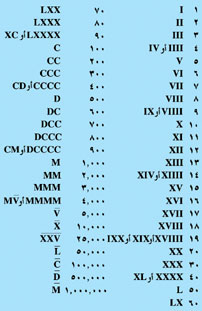
Roman numerals are an old way of writing numbers, used by the Romans more than two thousand years ago. They don't use the digits we know but letters: I means 1, V means 5, X means 10, L means 50, C means 100, D means 500 and M means 1000.
🤩 Did you know?
- All Roman numbers are written with just seven symbols.
- There is no zero in Roman numerals.
- The number 2026 is written MMXXVI in Roman numerals.
- On many clocks the number 4 is written like this: IIII.
🔎 Find out more
🌟 How do we write them?
We add the symbols from left to right: II means 2, VI means 5 + 1 = 6, XX means 20, and XV means 15.
🔍 The subtraction rule
If a smaller symbol comes before a bigger one, we subtract it: IV means 5 - 1 = 4, IX means 10 - 1 = 9, and XL means 40. The Romans sometimes wrote IIII instead of IV.
💡 Where do we see them today?
We still see Roman numerals on some clocks, in book chapter numbers, in kings' names like “Louis XIV”, and in the dates old buildings were built.
🎯 Why did we stop using them?
Roman numerals are hard to calculate with: there's no zero, and big numbers get very long. So people preferred Arabic numerals, which are much easier.
🧩 Test yourself
1 What does the symbol X mean?
2 How is 4 usually written in Roman numerals?
3 On many clocks the number ?? is written like this: IIII.
4 Which picture shows “Roman numerals”?