Seasons
📖 In short
There are four seasons in a year: spring, summer, autumn and winter. Each lasts about three months and brings changes in temperature, weather and day length. But why do the seasons change?
🤩 Did you know?
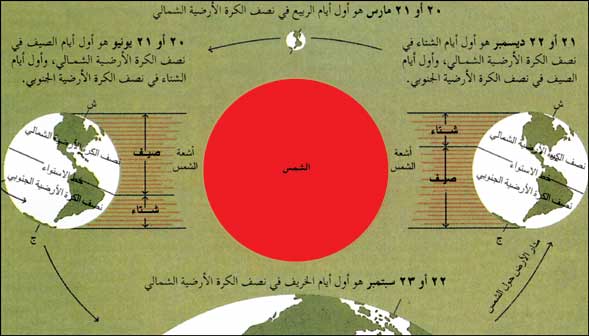
- In the northern half, spring begins on 20 or 21 March.
- Autumn begins on 22 or 23 September.
- Summer begins at the summer solstice, around 21 June.
- Near the equator the seasons don't change much; instead there's a rainy season and a dry season.
🔎 Find out more
🌟 The secret of the Earth's tilt
The Earth's axis is tilted a little. As the Earth goes around the Sun, its northern half leans towards the Sun for part of the year, bringing summer, and away from it for another part, bringing winter.
🔍 Opposite seasons
When it's summer in the Arab world and Europe in the northern half, it's winter in Australia and Argentina in the southern half, and the other way round!
💡 Spring and autumn
In spring flowers open, birds return and days get longer; in autumn the leaves of some trees turn red and yellow and fall, and days get shorter.
🎯 Longest and shortest day
In the northern half, the longest day of the year is around 21 June and the shortest around 21 December. At the equinoxes, day and night are nearly equal.
🧩 Test yourself
1 Why do the seasons change?
2 If it's summer here, what is it in Australia?
3 Summer begins at the summer solstice, around ?? June.
4 Which picture shows “Seasons”?