The story of the computer
📖 In short
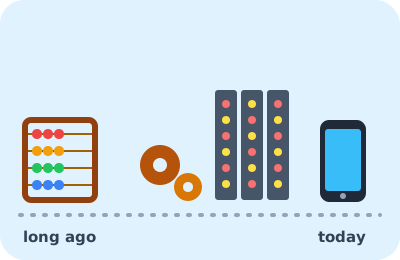
Thousands of years before computers, people counted on their fingers and with pebbles, then they invented the bead abacus. Over time they built calculating machines with gears, then giant computers the size of a room, until we reached a little computer that fits in your pocket.
🤩 Did you know?
- In 1947 a computer stopped working, and the scientists found a moth stuck inside it! Ever since, programmers have called a mistake in a program a “bug”.
- ENIAC had about 18,000 glass tubes.
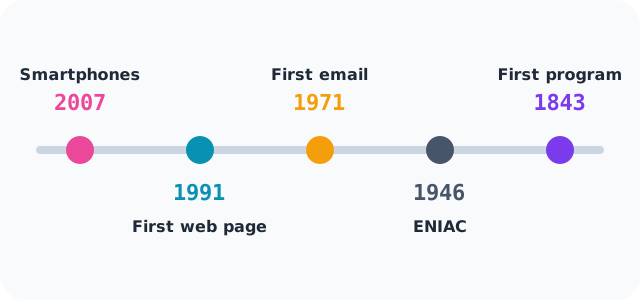
- The first email was sent in 1971, and its sender chose the @ symbol to separate the person's name from the name of their computer.
- The programming language “Ada” was named in honor of Ada Lovelace, the first programmer in history.
🔎 Find out more
🌟 The abacus: the first calculator
An abacus is a frame with rods of beads that you slide to add and subtract quickly. Traders have used it for a very long time, and some children still learn arithmetic with it today.
🔍 Machines made of gears
In the 19th century, the Englishman Charles Babbage designed a machine of gears that could follow instructions. And Ada Lovelace wrote for it what is considered the first computer program in history, before any real computer existed!
💡 Giants the size of a room
In 1946 the ENIAC computer was built in America. It filled a whole room and weighed about 27 tonnes, heavier than four elephants, and had thousands of glass tubes that kept burning out and being replaced.
🎯 A computer for every home, then every pocket
With the invention of tiny electronic parts, computers got smaller and smaller. In the 1980s they came into homes, then they became portable, and today we carry smartphones in our pockets that are far more powerful than the giant ENIAC.
🧭 Al-Khwarizmi and zero
More than a thousand years ago in Baghdad, al-Khwarizmi explained arithmetic with decimal digits, including zero. Without these digits, building computers would have been much harder.
🌈 From tubes to chips
The big glass tubes were replaced by little parts called “transistors”, and then it became possible to put billions of transistors on one chip the size of a fingernail.
📊 See how it works
📚 Key words
- Abacus
- A frame with beads for counting
- Transistor
- A tiny electric switch that computers are built from
- Chip
- A small piece holding billions of transistors
🧪 Try it at home
Make a simple abacus: poke holes in a shoebox, push three sticks through and put ten pasta tubes on each: one stick for ones, one for tens and one for hundreds. Then do sums with it!
🧩 Test yourself
1 Who wrote the first computer program in history?
2 How big was the ENIAC computer?