Prime numbers
📖 In short
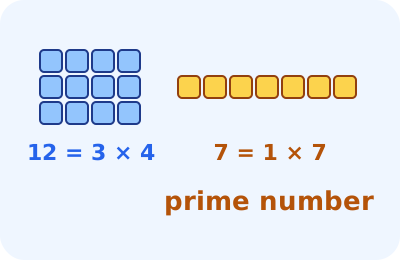
Try arranging 12 cubes into a rectangle: you can make 3 rows of 4, or 2 rows of 6. But 7 cubes can only go in one long row! The number 7 is a “prime number”: it can only be divided by 1 and itself.
🤩 Did you know?
- There are 25 prime numbers between 1 and 100.
- The number 2 is the only even prime number.
- Prime numbers never run out: the scholar Euclid proved it more than 2000 years ago.
- The biggest prime number known today has more than 41 million digits!
🔎 Find out more
🌟 What is a prime number?
A prime number is a number bigger than 1 whose only factors are 1 and itself. The first prime numbers are: 2, 3, 5, 7, 11, 13, 17, 19, 23, 29.
🔍 One isn't prime
It may surprise you, but 1 isn't a prime number, because it has only one factor: itself. And 2 is the only even prime number, because every other even number can be divided by 2.
💡 The sieve of Eratosthenes
An ancient Greek scholar called Eratosthenes invented a clever method: write the numbers from 2 to 100, then cross out the multiples of 2, then of 3, then 5, then 7. The numbers left uncrossed are the primes!
🎯 The building blocks of numbers
Every number can be written as primes multiplied together, like building blocks: 12 = 2 × 2 × 3. That's why scientists love prime numbers, and today they're used to protect messages and accounts on the internet.
🧮 Worked examples
- 13 = 1 × 13It can only be divided by 1 and 13: it's prime.
- 15 = 3 × 5It can be divided by 3 and 5: it isn't prime.
- 30 = 2 × 3 × 5Breaking 30 into prime numbers.
📚 Key words
- Prime number
- A number bigger than 1 that can only be divided by 1 and itself
- Factor (divisor)
- A number that divides another with nothing left over, like 3 is a factor of 12
- Multiple
- A number times 1, 2, 3…, like 6, 9 and 12 are multiples of 3
🧪 Try it at home
Write the numbers 1 to 50 in a grid, then try the sieve of Eratosthenes: cross out 1, then all the multiples of 2 (after 2), then multiples of 3, 5 and 7. Color the numbers left: how many primes did you find?
🧩 Test yourself
1 Which of these numbers is prime?
2 What is the only even prime number?
3 Is 1 a prime number?