The story of numbers
📖 In short
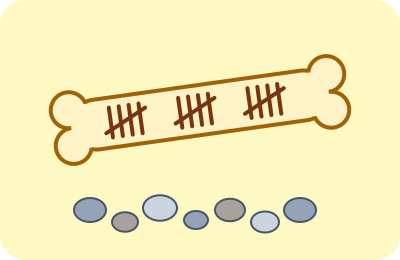
Thousands of years ago people had no written numbers. A shepherd counted his sheep with pebbles or with lines scratched on a bone or a stick. Then peoples invented symbols for numbers, until we arrived at the ten digits we use today to write any number we like.
🤩 Did you know?
- The carved Ishango bone is more than 20,000 years old.
- With just ten digits we can write any number, however big.
- The Babylonians counted in sixties, which is why an hour still has 60 minutes and a minute 60 seconds.
- The word “calculate” comes from the Latin calculus, meaning “small pebble”: pebbles were the first counting tool.
🔎 Find out more
🌟 Counting with fingers and pebbles
The first calculator in history was our fingers! And because we have ten fingers, people began grouping things in tens. A shepherd put down a pebble for each sheep that went out, then picked one up for each sheep that came back, so he knew if any were lost.
🔍 Carved bones
Scientists have found very old bones with lines carved in rows, like the Ishango bone in Africa. They think its owner used it to count days or things, so it's one of the oldest signs of counting by humans.
💡 Symbols of ancient peoples
The people of Mesopotamia wrote numbers as marks on clay tablets, and the ancient Egyptians used symbols: a stick for one, a horseshoe shape for ten and a coiled rope for a hundred. Writing was long: to write 99 they drew 18 symbols!
🎯 The ten digits
In India a wonderful idea appeared: just ten symbols, from 0 to 9, with a digit's value changing according to its place. Muslim scholars took up this method and developed it, and from them it passed to Europe and then the whole world.
🧮 Worked examples
- ||||| ||| = 8We draw a line for each thing and group the lines in fives so we can count them quickly: 5 + 3 = 8.
- 10 + 10 + 10 + 4 = 34Like the ancient Egyptians: three horseshoes (three tens) and four sticks (four ones).
📚 Key words
- Number
- How many things there are, like five pencils
- Digit
- The symbol we write a number with, like 5 or ٥
- Counting
- Saying the numbers in order to find out how many things we have
🧪 Try it at home
Gather a handful of pebbles or dried beans and use them to count your family or your books: put down one bean for each thing, then arrange the beans in groups of ten. How many groups did you make? And how many beans are left over?
🧩 Test yourself
1 What did shepherds long ago use to count their sheep?
2 How many digits do we need to write every number?
3 Why do we count in tens?