Subtraction: how many are left?
📖 In short
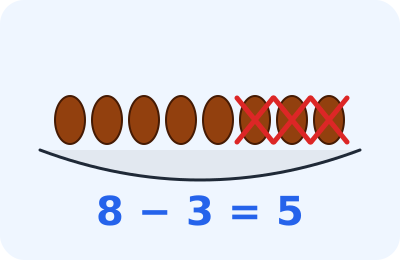
There were 8 dates on the plate and I ate 3. How many are left? 5! Subtraction answers “how many are left?” and “what's the difference?”. We write it with the − sign, read “minus”, and the answer is called the “difference”.
🤩 Did you know?
- Any number − 0 = the same number, and any number − itself = 0.
- The − and + signs first appeared together in a German book in 1489.
- Subtraction helps us work out our age: 2026 − 2016 = 10 years.
- We subtract every day without noticing: how much time is left before dinner?
🔎 Find out more
🌟 Subtraction undoes addition
If 5 + 3 = 8, then 8 − 3 = 5 and 8 − 5 = 3. These three numbers are one “family”. So we check subtraction with addition: add the difference to what we took away and we get the first number back.
🔍 Order matters
In addition we can swap the numbers as we like, but not in subtraction! 9 − 4 = 5, but 4 − 9 isn't possible with the numbers we learn in primary school, because we can't take 9 from 4.
💡 Counting on
To work out 52 − 47 we don't have to count backwards. We count from 47 to 52: 48, 49, 50, 51, 52, five steps. The difference is 5. That's how shopkeepers work out change.
🎯 Borrowing
If the top ones digit is smaller, we borrow a ten from the tens place. 42 − 17: we can't take 7 from 2, so we borrow: 12 − 7 = 5, then 3 − 1 = 2. The difference is 25.
🧮 Worked examples
- 15 − 6 = 9Because 9 + 6 = 15.
- 80 − 35 = 45From 35 to 40 is five, and from 40 to 80 is forty: 5 + 40 = 45.
- 53 − 28 = 25We borrow: 13 − 8 = 5, then 4 − 2 = 2.
📚 Key words
- Subtraction
- Taking one number from another to see what's left
- Difference
- The answer to a subtraction
- Borrowing
- Taking a ten from the tens place so we can subtract the ones
🧪 Try it at home
Put 20 dried beans on the table. Ask your brother to hide some under a cup without you seeing. Count the beans you can see and work out how many are under the cup. Then lift the cup and check!
🧩 Test yourself
1 What is 14 − 6?
2 If 9 + 7 = 16, what is 16 − 7?
3 What is 61 − 25?