Tessellations and geometric patterns
📖 In short
In Moroccan zellige tilework, in mosque domes and on the doors of Andalusian palaces, geometric shapes repeat and interlock with no gaps. This is “tessellation”: covering a surface with shapes that fit together perfectly, like floor tiles. Muslim artists created some of the most beautiful patterns in the world with it.
🤩 Did you know?
- The Alhambra in Granada has geometric patterns more than 600 years old.
- Only three regular polygons tile a surface on their own: the triangle, the square and the hexagon.
- Bees' hexagonal cells meet in threes at each corner, at angles of 120 degrees.
- Moroccan zellige is made from small colored pieces of clay cut by hand.
🔎 Find out more
🌟 Shapes that fit together
Some shapes cover a floor on their own with no gaps: the square, the equilateral triangle and the hexagon. Circles and regular pentagons don't: they leave gaps between them.
🔍 The secret of the angles
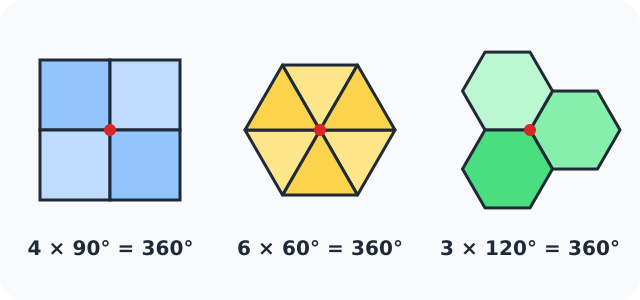
Around every point where tiles meet, the angles must add up to exactly 360°. Four squares: 4 × 90° = 360°. Six triangles: 6 × 60° = 360°. Three hexagons: 3 × 120° = 360°.
💡 Islamic patterns
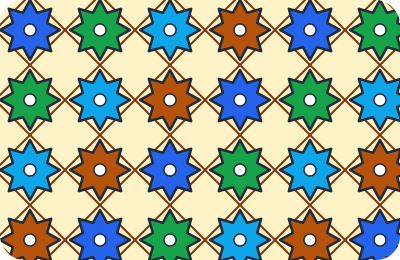
Muslim artists drew stars with 8, 10 and 12 points interlocking with other polygons, using only a compass and a ruler. We see them in the Alhambra in Granada, in the madrasas of Fez and in the mosques of Isfahan and Cairo.
🎯 Tessellations in nature
Bees build their cells as hexagons side by side, the scales of some fish and snakes fit together, and in Northern Ireland there are hexagonal rocks called the “Giant's Causeway”.
📊 See it in a picture
🧮 Worked examples
- 4 × 90° = 360°Four squares meeting at a point.
- 6 × 60° = 360°Six equilateral triangles.
- 3 × 120° = 360°Three hexagons, like honeycomb cells.
📚 Key words
- Tessellation
- Covering a surface with shapes that fit together with no gaps or overlaps
- Zellige
- Moroccan tilework of colored pieces arranged in geometric patterns
- Regular polygon
- A polygon with equal sides and equal angles
🧪 Try it at home
Cut out 12 equal triangles from colored paper and try to cover a space with no gaps. Then try with squares and circles. Which ones worked? Make your own pattern!
🧩 Test yourself
1 Which shape tiles a surface on its own with no gaps?
2 What must the angles around the point where tiles meet add up to?
3 Where can we find famous Islamic geometric patterns?