Math in nature
📖 In short
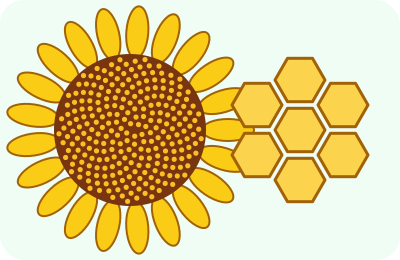
Count flower petals: many have 3, 5, 8 or 13. Look at the middle of a sunflower: its seeds are arranged in beautiful spirals. And honeycomb cells are perfect hexagons. Nature is full of numbers and shapes, like an open math book!
🤩 Did you know?
- A sunflower's center usually has 34 spirals one way and 55 the other: two numbers from the Fibonacci sequence.
- A starfish usually has 5 arms.
- Bees visit about two million flowers to make 500 grams of honey.
- Every snowflake has 6 arms, because water molecules join up at angles of 60 degrees.
🔎 Find out more
🌟 The Fibonacci sequence
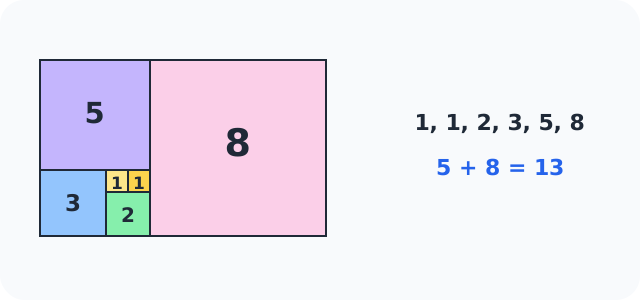
1, 1, 2, 3, 5, 8, 13, 21, 34… Each number is the sum of the two before it. This is the Fibonacci sequence, and we find its numbers in flower petals, in the seed spirals of sunflowers, in pineapple scales and in pine cones.
🔍 Bees' hexagons
Bees build hexagonal cells because hexagons fill the space with no gaps and need the least wax to store the most honey. A little engineer with no ruler!
💡 Snails and spirals
A snail's shell and the shell of the sea nautilus curl in a spiral that grows evenly. We see the same spiral in hurricanes and in faraway galaxies!
🎯 Symmetry in living things
Butterflies, people and fish have a line of symmetry, a starfish has 5 matching arms around its center, and a snowflake has 6. Symmetry helps living things stay balanced as they move.
📊 See it in a picture
🧮 Worked examples
- 1, 1, 2, 3, 5, 8, 1313 = 5 + 8, and the next number is 8 + 13 = 21.
- 3 × 120° = 360°Three honeycomb cells meeting at a point.
📚 Key words
- Sequence
- Numbers in order that follow a rule
- Spiral
- A line that curls around a center, moving further away bit by bit
- Petal
- The colored part of a flower
🧪 Try it at home
Collect different flowers from the garden (or look at pictures) and count each one's petals. Write the numbers down: how many are in the Fibonacci sequence 3, 5, 8, 13?
🧩 Test yourself
1 What is the next number in the sequence 1, 1, 2, 3, 5, 8?
2 What shape is a honeycomb cell?
3 How many arms does a starfish usually have?