🏷️ Definite and indefinite articles
📖 In short
In French, before every noun we put a little word called the “article”. It tells us whether the noun is masculine or feminine, singular or plural, and whether it's a particular thing or not.
🔎 The lesson
1 Definite articles: le, la, les
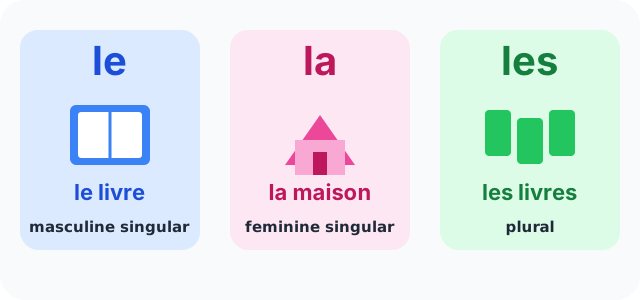
Like “the” in English: we use them when talking about a particular thing.
| Masculine singular | Feminine singular | plural |
|---|---|---|
| le | la | les |
- le chatThe cat
- la maisonHouse
- les livresThe books
2 l' before a vowel
If the noun starts with a vowel or an h, we drop the e or a from the article and add an apostrophe: l'.
- l'arbreTree
- l'écoleSchool
- l'hôpitalThe hospital
3 Indefinite articles: un, une, des
We use them for something not particular, like “a” or “some” in English.
| Masculine singular | Feminine singular | plural |
|---|---|---|
| un | une | des |
- un chienA dog
- une pommeAn apple
- des fleursFlowers
📊 In a picture
💡 Watch out!
- Learn every new noun with its article: don't learn table on its own, but la table.
- des often has no English word to match (or just “some”), but you can't leave it out: J'ai des crayons.
🧩 Test yourself
1 Choose the article: ... maison
2 Choose the article: ... arbre
3 What is the plural of un chat?
→ The family in French← Masculine and feminine
📚 Related lessons
- 👦 Masculine and feminine
- 🍎 Plurals in French
- 🙋 Personal pronouns
- 🎨 Adjectives and agreement
- 🚫 Saying no: ne ... pas
- ❓ How do we ask questions in French?
- 📦 Place words: sur, sous, dans
- 🎒 Possessives: mon, ma, mes
- 👉 Demonstratives: ce, cette, ces
- 🥖 du, de la, des: some of something
- 👀 c'est and il y a
- ⚖️ Comparing: plus, moins, aussi
- 🎧 Sound-alike words: a / à and et / est