🎒 Possessives: mon, ma, mes
📖 In short
To say “my book”, “your bag” or “his toys”, we put a little word before the noun that shows who it belongs to. It changes depending on the owner, and on the thing itself: masculine, feminine or plural.
🔎 The lesson
1 The table
| Owner | Masculine | Feminine | plural |
|---|---|---|---|
| I | mon | ma | mes |
| You | ton | ta | tes |
| He / she | son | sa | ses |
| We | notre | notre | nos |
| You (several) | votre | votre | vos |
| They | leur | leur | leurs |
2 Examples
- mon livreMy book
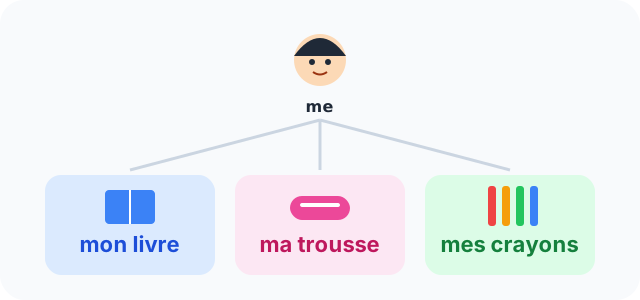
- ma trousseMy pencil case
- mes crayonsMy pencils
- notre maisonOur house
- leurs jouetsTheir toys
3 son and sa: watch out!
In English we say “his house” or “her house”. But in French son and sa follow the thing, not the owner: la maison is feminine, so we say sa maison whether the house belongs to a boy or a girl.
- Sami prend sa trousse.Sami takes his pencil case.
- Lina prend son cartable.Lina takes her school bag.
4 mon before a vowel
Before a feminine noun starting with a vowel we say mon instead of ma to make it easier to say: mon amie, mon école.
📊 In a picture
💡 Watch out!
- notre and votre are the same for masculine and feminine.
🧩 Test yourself
1 “My pencil case” (la trousse):
2 Lina takes her book (le livre):
3 “My friend (a girl)” (une amie):
→ Place words: sur, sous, dans← Demonstratives: ce, cette, ces
📚 Related lessons
- 🏷️ Definite and indefinite articles
- 👦 Masculine and feminine
- 🍎 Plurals in French
- 🙋 Personal pronouns
- 🎨 Adjectives and agreement
- 🚫 Saying no: ne ... pas
- ❓ How do we ask questions in French?
- 📦 Place words: sur, sous, dans
- 👉 Demonstratives: ce, cette, ces
- 🥖 du, de la, des: some of something
- 👀 c'est and il y a
- ⚖️ Comparing: plus, moins, aussi
- 🎧 Sound-alike words: a / à and et / est