⏮️ The passé composé
📖 In short
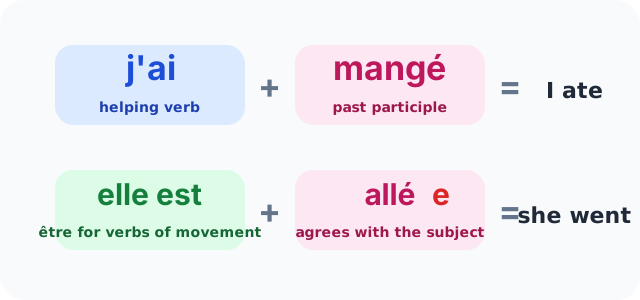
To talk about what happened in the past we usually use the passé composé. It has two parts: a helper verb (avoir or être) in the present, then the verb's past participle: J'ai mangé (I ate).
🔎 The lesson
1 avoir + past participle
| Pronoun | Verb |
|---|---|
| j' | ai joué |
| tu | as joué |
| il / elle | a joué |
| nous | avons joué |
| vous | avez joué |
| ils / elles | ont joué |
2 Making the past participle
-er verbs end in -é, and second-group verbs like finir end in -i. Some irregular verbs have to be learned by heart.
| Infinitive | past participle |
|---|---|
| jouer | joué |
| finir | fini |
| avoir | eu |
| être | été |
| faire | fait |
| prendre | pris |
| voir | vu |
3 Movement verbs with être
Some verbs like aller, venir, partir, arriver and tomber take être, and the participle agrees with the subject: add e for feminine and s for plural.
- Je suis allé au parc.I went to the park (a boy).
- Je suis allée au parc.I went to the park (a girl).
- Ils sont partis hier.They left yesterday.
📊 In a picture
💡 Watch out!
- Words that show the past: hier (yesterday), la semaine dernière (last week), ce matin (this morning).
🧩 Test yourself
1 Hier, j'... un gâteau.
2 Elle est ...
3 What is the past participle of finir?
→ The verbs aller and faire in the present← The futur proche
📚 Related lessons
- 🌟 The verb être in the present
- 🎒 The verb avoir in the present
- 🎵 First-group verbs in the present
- 🏁 Second-group verbs in the present
- 🚶 The verbs aller and faire in the present
- ⏭️ The futur proche
- 🪥 Reflexive verbs: je me lave
- 📣 Commands: Range ta chambre !
- 🕰️ The imparfait
- 🚀 The futur simple
- 🚌 The verbs prendre and venir in the present
- 🙏 pouvoir, vouloir and devoir